
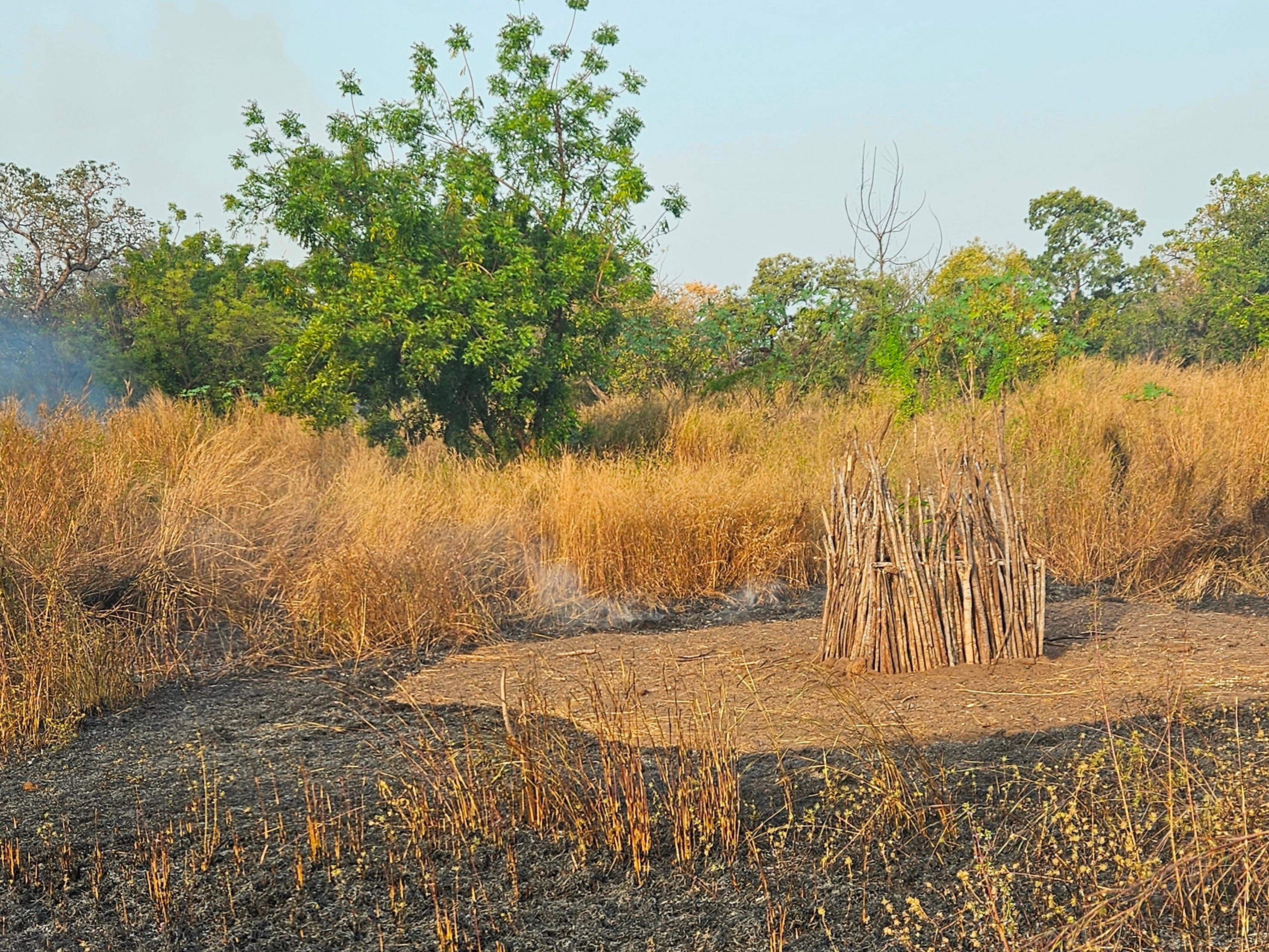
For decades, fire in Northern Ghana has been treated as a problem. Government policies, development projects and conservation initiatives have largely framed burning as a threat to forests, biodiversity, agricultural productivity and climate goals. Yet fire remains deeply embedded in daily life across the savanna, used to prepare farmland, manage grazing, hunt, protect homesteads and support cultural practices.
Two recent studies offer a rare opportunity to examine this tension from different angles. One analyses more than two decades of satellite evidence on fire activity across Northern Ghana. The other investigates how policymakers and institutions construct traditional burning as an environmental problem. Together, they tell a powerful story about changing fire regimes, governance, knowledge and the consequences of whose understanding of fire becomes dominant in environmental decision-making.
The first study combines MODIS and Landsat satellite data with institutional interviews to understand changing fire regimes between 2000 and 2022. At first glance, the results appear encouraging for advocates of fire suppression. Large fires detected through coarse-resolution MODIS data have declined significantly in several regions, particularly Savannah, Upper East and Upper West. Stakeholders attributed these changes to fire management campaigns, restoration projects and government interventions designed to reduce uncontrolled burning.
Yet the picture becomes more complex when different datasets and spatial scales are considered. Unlike MODIS, the Landsat-derived Global Annual Burned Area Mapping dataset showed no significant overall trend in burned area, while active fire data revealed an increase in the Northern Region. These contrasting patterns demonstrate that there is no single story of fire change in Northern Ghana. Rather, what we observe depends partly on the scale, resolution and characteristics of the satellite data used. Aggregating the landscape into one overall trend can also mask important sub-national differences in how fire regimes are changing.
The research also identifies a shift in seasonality. Fires are occurring less often in November and more often in January and February across Northern Ghana. This matters because many projects and policies continue to promote “early burning” without clearly defining what that means in practice. The observed trends suggest that fire management strategies may not be fully aligned with how people actually use fire on the ground.
The second study asks a different question: how did fire become a policy problem in the first place?
Using Carol Bacchi’s “What’s the Problem Represented to Be?” framework, the researchers examine contemporary fire-related policies in Ghana. They find that traditional burning practices are routinely described using terms such as “bushfires”, “wildfires” and “uncontrolled burning”. By grouping diverse burning practices under these labels, policies often obscure important distinctions between destructive fires and controlled, intentional burns used for livelihood and land management purposes.
This framing has deep historical roots. Colonial administrators viewed West African savannas through a forestry lens and associated fire with deforestation and degradation. Although later research demonstrated the ecological benefits of some burning practices, anti-fire narratives became embedded within institutions and persisted through post-independence development agendas. Today they are being reinforced through climate mitigation, carbon accounting and restoration programmes.
The result is what the authors describe as a technocratic approach to fire governance. Environmental challenges are presented as problems of knowledge, behaviour and management that can be solved through awareness campaigns, regulation, tree planting and behavioural change. Traditional fire knowledge, meanwhile, often receives less attention than scientific and institutional expertise.
Perhaps the most fascinating insight emerges when both papers are read together.
The satellite evidence shows that understanding fire depends on how it is measured. Different datasets reveal different aspects of changing fire regimes, while sub-national analysis exposes patterns that are hidden when Northern Ghana is viewed as a whole. The policy analysis shows that understanding fire also depends on how it is represented. By framing diverse burning practices as a single environmental problem, fire governance has often focused on changing fire behaviour rather than understanding the social, economic and ecological realities that make burning necessary. In this sense, both studies reveal the importance of representation in shaping how fire is understood, measured and governed.
Both studies ultimately argue for a more nuanced approach. Rather than treating all fire as harmful, policymakers may need to distinguish between different types of burning, recognise the ecological role of fire in savanna landscapes, and engage more seriously with local knowledge and livelihood needs. Effective fire governance, the authors suggest, requires understanding not only where and when fires occur, but also why people continue to use them, how different forms of knowledge shape management decisions and how policies affect different social groups whose livelihoods depend on fire use.
As debates about climate adaptation, carbon sequestration and landscape restoration intensify across Africa, Northern Ghana offers an important lesson. Environmental governance is rarely just about ecology. It is also about power, knowledge and whose understanding of the landscape counts, whose practices are recognised and who bears the cost of environmental interventions.
The challenge is therefore not simply to stop fires, but to govern them in ways that reflect the complexity of changing fire regimes and the realities of the people who live with them every day. The future of fire management depends not only on better monitoring and stronger policies, but also on building more equitable relationships between scientific evidence, institutional authority and communities whose lives and livelihoods are shaped by fires.
Alare, R.S., Schreckenberg, K. & Tebbs, E. (2026) Navigating Discourses: Unpacking the Problematisation of Traditional Burning Practices in Northern Ghana. Journal of Pyrogeography, 3, 100017. https://doi.org/10.1016/j.pyro.2026.100017
Alare, R.S., Tebbs, E. & Schreckenberg, K. Diverging fire trends in Northern Ghana’s savanna landscape: insights from remote sensing and institutional perspectives. fire ecol 22, 102 (2026). https://doi.org/10.1186/s42408-026-00553-w
Rahinatu Sidiki Alare is a PhD researcher in the Department of Geography at King’s College London. Her research explores natural resource governance, fire management, equity and conflict in Northern Ghana, combining remote sensing with local ecological knowledge to understand the impacts of environmental policy on communities.
Professor Kate Schreckenberg is Professor of Environment and Development at King’s College London. An interdisciplinary researcher with extensive experience across Africa, Asia and Latin America, she specialises in natural resource governance, environmental justice, livelihoods, conservation policy and landscape management.
Dr Emma Tebbs is Senior Lecturer in Physical Geography and Earth Observation at King’s College London. Her research focuses on remote sensing and Earth observation technologies for conservation, sustainable development and environmental monitoring, particularly in Africa.